
January 18, 2025
By Maud Karambis
Although the United States is a religiously diverse country, white Christians are 42% of the population. Trump won 80% of white Evangelical votes—up from 76% in 2020, and closer to the support he received in 2016 (80%). He also secured increased backing from Hispanic Christians, many of whom were swayed by Trump’s economic policies. For many political elites, the consistency of Christian support for Trump is surprising considering his lifestyle, which some see as contrary to Christian values. However, when asked about their continued support, Christian supporters cite his success in overturning Roe v. Wade and his promises to enact policies that embolden Christianity. This consistent support is a significant victory for Trump, as white Evangelicals make up 25% of voters.
Trump has had underlying support from Christians since he entered the political scene, stemming from the more traditional Christian right. This group has been championing far-right policies similar to Trump’s since the 1970s. The group began forming after the landmark Supreme Court case Brown V. Board of Education desegregated public schools. In response, many white parents moved their children to private, religious, and segregated schools. In the 70s, the IRS began to enforce Green v. Connally, a Supreme Court decision that denied tax exemptions to schools that justified segregation through religion. This led the Christian right to politically mobilize. However, the group knew that a political movement built on segregation wouldn’t be able to garner widespread support.
Fueled by a rise in political consciousness, the idea of “protecting fetuses,” was created by activists like Phillis Schlafly. Once the foundational message of the movement became protecting the helpless, the Christian Right began to grow. Eventually, the group played a key role in events like the loss of nationwide abortion rights and the Jan 6. insurrection in the Capitol. According to Talia Lavin, author of “Wild Faith: How the Christian Right is Taking over America,” overturning Roe v. Wade was a central goal for the Christian right, but they also sought to erase practically all social progress since the 1960s, leaving the nation with political policy reminiscent of the 1950s.
For many supporters, even before the attempt on Trump’s life, religion was already central to their politics. Trump was able to become a messianic figure; he offers supporters reassurance that someone will “save our country and .. restore America to greatness.” In a religion built around a strict moral framework, this rhetoric creates hope for a more moral world. Trump is also able to step into a priestlike role, preaching the creation of a more Christian world to gain support. Voting for Trump becomes a religious act. In response to criticism of Trump’s unorthodox lifestyle, supporters argue that, like Trump, all of us have sinned, but God chose Trump when he spared his life. To many Christians, he has proved himself their divinely appointed savior by orchestrating the end of nationwide abortion rights. He could plausibly go further with a national abortion ban, although he claims he won’t, which could cement his prophet-like status for Christian supporters.
As the Christian population declines in America, fears of loss of “white” and Christian culture are on the rise. This has emerged in conspiracy theories like the great replacement theory, a theory spouted by Tucker Carlson and other public figures on the right. The great replacement theory, claims that welcoming immigration policy, specifically towards non-white immigrants, is a government ploy to “replace” White America. Trump’s rhetoric tapped into these fears, through campaign promises like restoring “power to the Christian Churches” or his slogan “Make America Great Again.” Many Christians believe that Trump will restore America to what they see as its traditional Christian roots. He also provides Christians protection from what many see as an anti-Christian government agenda. “We believe the president will defend religious freedom where the Democrats would not,” said Reverend Franklin Graham, a prominent Christian speaker. Reverend Graham also feels supported by Trump regarding pro-LGBTQ and other anti-Christian legislation, “that would make it very difficult for people of faith;” he feels confident that under the new Trump administration this legislation “will not come.” This protection extends beyond legislation, Trump has promised to form a task force to combat the “persecution against Christians in America.” He has also vowed to “protect Christians in our schools and in our military and our government” and in “our public square,” proving that he will protect Christians by supporting these controversial policies.
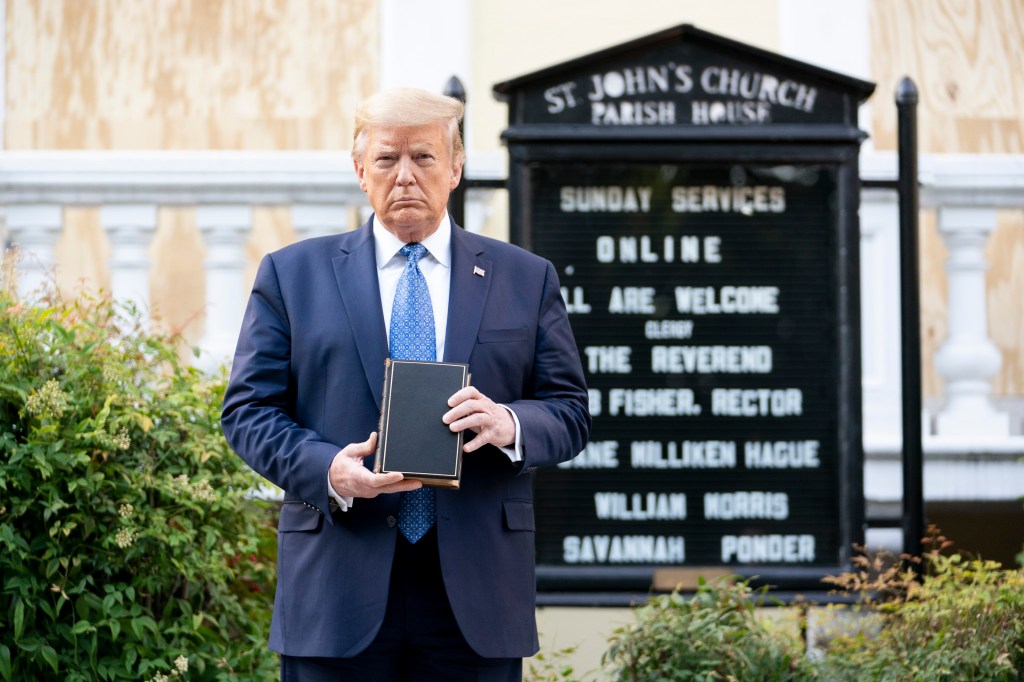
The Christian right, partly came out so strongly in support of Trump spurred on by a prophecy made in 2016. This prophecy claimed that he was a reincarnated version of King Cyrus, who like Trump was a flawed person, but once chosen by God went on to perform His will. Prophecy plays a large role in the world of Evangelicals and for them, this prophecy was fulfilled when Roe V Wade was overturned.
Lavin cites another reason behind the intense backing from the Christian right. The “satanic panic,” a 1980s frenzy where parents, psychiatrists, and psychologists falsely claimed that daycare workers were satanically abusing children. Lavin argues that this “panic” never went away and just became the modern-day paranoia that the devil is present in public life and particularly education. Lavin claims that Moms for Liberty, a political organization aiming to rid our schools of discussions of LGBTQ rights and race, has rhetoric reminiscent of the parents during the satanic panic. Through his rhetoric, Trump offers relief from this panic, he validates their fears and becomes their hero.
JD Vance converted from Evangelical Christianity to Catholicism, both because of his connection to the church’s theological values, and the church’s values related to family, virtue, and general social life. This acted as a foundation for Vance’s political worldview and populism. As he claimed, “I saw a real overlap between what I would like to see [in the world] and what the Catholic Church would like to see.” Vance’s form of catholicism is rooted in tradition and emphasizes family values and the value of public Christianity. Vance found Christianity offered him an escape from elitist ideals about jobs and education, allowing him to find a community that valued more traditional ideals and gender roles.
Vance, like others, claims God saved Trump’s life: “You will never be able to convince me that that last second turn of a head was anything other than a miracle,” he said. “I absolutely believe that.” Both Vance and Trump have shown Christians that they are willing to deliver on a Christian nationalist agenda. Trump provides voters with his readiness to extreme action while Vance provides voters with a genuine commitment to traditional Christian values.
Trump critics fear that Trump will abandon the idea of separation of church and state and privilege Christians in America, imposing Christian will onto the whole nation. This could trigger the ostracization of non-Christian Americans, and could strongly impact policy. The infamous Project 2025, to which members of Trump’s cabinet are closely connected, has a Christian nationalist outline. Secular groups have already promised to combat any policies that enact Christian nationalist agendas.
Trump now has free reign to enact more of the Christian right’s policies, some of which Project 2025 outlines: prohibiting divorce without a valid reason, banning birth control, anti-gay laws, and allowing racial segregation, to name just a few. The Christian right wants biblical laws made a reality, and Trump has shown his willingness to provide it.
Whether Trump delivers is another question entirely. He may not deliver on economics or jobs or even international relations but if he is willing to deliver on pro-Christian policies, that could be enough to keep Trump’s approval rating high. For many in the Christian right, religion is their fundamental value, and they could be willing to sacrifice their rights or other beneficial policies to uphold their most important value.
Maud Karambis can be reached at Karambis2@kenyon.edu

The People’s Party
Zohran Mamdani Will Spark a New Movement for Change Photo Credit: Michael M. Santiago By Angus Allan As I watch the mayoral campaign of Zohran Mamdani this October, I can’t help but think back to last year, when I was casting my mail-in ballot for Kamala Harris. Although I was hopeful that my vote would…


The Death of Comedy
By Oliver Giraud Every August, when first-year students arrive at Kenyon, they sing. Since 1965, when acting President Frank Bailey started the tradition, new students have stood on the steps of Rosse Hall to perform three or four Kenyon songs—while seniors sing along, laugh, heckle, and jeer. Recently, however, the First-Year Sing has undergone controversial…

The Grahampaign – Graham Platner’s race for the Senate
_______________________________________________________________________________ September 25th, 2025 By: Henry Haile “America has entered a new Gilded Age–” says Graham Platner– the second to announce his candidacy for Senator Susan Collins’ Senate seat in Maine. The military veteran oysterman running against Collins and “the billionaire class that owns her and all of Washington” is taking an unconventional approach in…


 Paths Magazine
Leave a comment